Categories
Close
Menu
Menu
Close
Search
Search

Featured Articles

Opinion

Google Dictation - "I shall say this only once"

Mark

Share:

Print

Rate article:

No rating
Rate this article:
No rating

James Rosewell writes:

Back in January 2010 I wrote a brief review of the Google Nexus One that included my thoughts on the not-so-accurate voice dictation feature. From the marketing hype, I had expected to simply speak into the phone and a few seconds later my words would appear as a perfectly formed text message. The reality was somewhat disappointing. For all but the simplest short phrases it struggled to produce the intended words, making it inferior to even the touch-screen keyboard.

Since January, one of two things have changed. Either I’m better at speaking [ed: regular podcast listeners may disagree] or Google has learnt more about the way people talk and has updated the service. The whole experience is definitely a lot more usable and I find myself subconsciously reaching for the 'dictation' button when composing a text message. This represents a whole new social challenge concerning mobile usage. I certainly feel a bit of an idiot sitting in coffee shop talking clearly into my mobile phone in short bursts. On the positive side, all my text messages are perfectly formed with “text speak” phrases like gr8 a thing of the past.

Google improving this service is a fantastic demonstration of the benefits of cloud computing. I had to do absolutely nothing for this service to become usable. Having all the smart stuff independent of the handset hardware means mobile devices can deliver new features and services without traditional limitations. Handsets won’t need to be replaced as frequently. However, in 2 or 3 years time when everyone will be using dictation, more network bandwidth will be consumed - and MNOs more than ever need to become a greater player in this new revenue model.
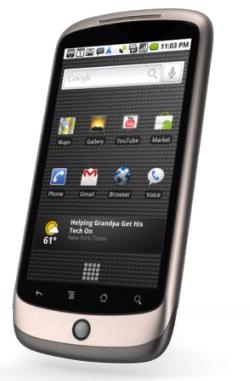
Google Nexus OnePS. Touch-screen keyboards still suck compared to their old fashioned tactile predecessors. However I fear they’re here to stay and voice dictation just might make the whole mobile experience even more usable. But a word of caution: don’t expect to use dictation when driving, it’s not that easy to use just yet!


Comments

Collapse Expand Comments (0)
You don't have permission to post comments.

Opinion Articles

ExclusiveThe great Windows Mobile 7 conspiracy theory

Mark Bridge writes:

I like a good conspiracy theory. A good one, mind you. None of this “Funny thing happened on the way to Mars” nonsense. Oh no, not me. And, despite occasionally mirroring Jerry Fletcher by balancing a bottle on the door handle, I’ve never been inclined to publish such a theory. Until now.

You see, it’s Mobile World Congress in a fortnight’s time. Which is when the great and the good of the mobile industry – along with their mates and hangers-on – head for Barcelona. Microsoft will be there. They’re holding a press briefing on Monday afternoon. And there’s a lot of talk about Windows Mobile 7 being (unofficially) on the agenda. But where’s the evidence?

ExclusiveA Sure Signal from Vodafone

Mark Bridge writes:

Today I've been using my mobile phone at home. For many people that’s not an unusual thing to do – but it is for me because, around here, coverage indoors isn’t particularly good. Downstairs it’s previously been non-existent. But this morning everything changed.

ExclusivePhysician uses cell phones to bring health care to the poor

Natalia Ardanza of voanews.com writes:

In Africa there is another use for mobile phones. Public Health workers in Kenya are now using mobile phones to gather health information from patients in remote areas and upload it to the internet for instant analysis at distant centers. And it is all happening thanks to Dr Joel Selanikio.

ExclusiveMaking dumb touchscreen phones was a smart move

Mark Bridge writes:

I remember a report from last year that said ‘non-smart’ touchscreen handsets – generally those without a popular operating system – would be bad news for mobile operators.

Conventional touchscreen smartphones tended to result in higher-than-average ARPU thanks to their early-adopting tech-loving users, their web-friendly browsers, their email programs, their app-friendly operating systems and their fast 3G connectivity. However, dumber touchscreen devices – those with a manufacturer’s own proprietary OS and perhaps a clumsier browser – could generate 23% less ARPU than smarter phones. So, if touchscreen dumbphones weren’t good for networks… and weren’t really good for consumers either… manufacturers wouldn’t really bother with them. Right?

Exclusive"Hello Nexus One" I say...

James Rosewell writes:

Mark’s been encouraging me to write an opinion piece on the Nexus One for the last few days and I’m finally putting fingers to keyboard to share my experiences. It’s taken so long because this phone has so many features. On a positive note I could go into details about the gorgeous screen, the Android Marketplace that will out-sell Apple’s over the next 18 months, the built-in satellite navigation service and the speedy processor that makes everything run smoothly in real time. Or on a less positive note, the touch screen keyboard that sucks (think carefully about this if you’re a heavy texter or emailer, it’s even worse than the original iPhone), the lack of ActiveSync for Calendars and Tasks, no support for WMA music files or the clunky zoom functions on the web browser.

However I’m going to focus on voice dictation. Nexus One is the first phone I’ve used with this feature.

RSS
First101102103104106108109110Last

Recent Podcasts

ExclusivePodcast from Mobile World Congress 2015

Mark Bridge learns about the mobile technology trends at Mobile World Congress 2015 by chatting to James Rosewell of 51Degrees, Dr Kevin Curran from the IEEE and Chris Millington of Doro.

They talk about wearable devices, wireless charging, mobile operating systems and much more... including some of their favourite products from the exhibition.

ExclusiveLooking back at February: from security scares to multiple MVNOs

We're taking a look back at the biggest mobile industry news stories from February 2015, including allegations that the UK's security service tried to breach SIM card security by hacking into one of the world's biggest SIM producers.

We also talk about the planned BT and EE merger, the creation of two new UK virtual networks, some acquisitions in the mobile payment arena and a new Ubuntu smartphone.

ExclusiveA month of mobile: O2 counts on 3, Microsoft counts to 10 and Apple counts its profits

We're back with a month of mobile industry news, including takeover talks and takeover rumours. O2 and Three are said to be discussing a merger... but is there any truth in the suggestions that BlackBerry could be up for grabs?

We also discuss Apple's record-breaking quarterly figures, the highlights of CES and the launch of Microsoft Windows 10, as well as saying farewell to the current version of Google Glass.

RSS
12345678910Last

Follow thefonecast.com

Archive Calendar

«June 2026»
MonTueWedThuFriSatSun
25262728293031
1234567
891011121314
15161718192021
22232425262728
293012345

Archive