James Rosewell writes:
Helping thefonecast.com answer this rather abstract question is the team at Mobile Monday who invited us to their Monday evening event in London dedicated to the subject. A panel of experts from various fields and countries were assembled to present on their experiences and debate the subject.
Any healthcare solution involving some component of mobile technology seems to come under the banner mHealth. That’s where the 'm' comes from after all. A solution that captures information about diabetes sufferers' blood sugar levels via prompted text messages and relays this information to a physician would be considered an mHealth solution. Providing feedback to the diabetes patient about a change in dosage following review by the physician makes the solution even better. Linking devices that automatically monitor blood sugar levels and dispense insulin involving a remote computer and physician to monitor the real-time situation moves the solution on a level still. All these examples show how mobile technology can be used to improve quality of life.
So the good news for the non-technologist [ed: such as Iain?] is there doesn’t need to be very much technology involved in mHealth solutions. The bad news is that the chain of components, individuals and organisations required to deliver these solutions is vast. Co-ordinating all these stakeholder groups to gain agreement is a herculean task. Barry Flaherty of Grow based in Qatar presented the following slide which highlights the stakeholder groups involved, and this doesn't even show patients and health care professionals.
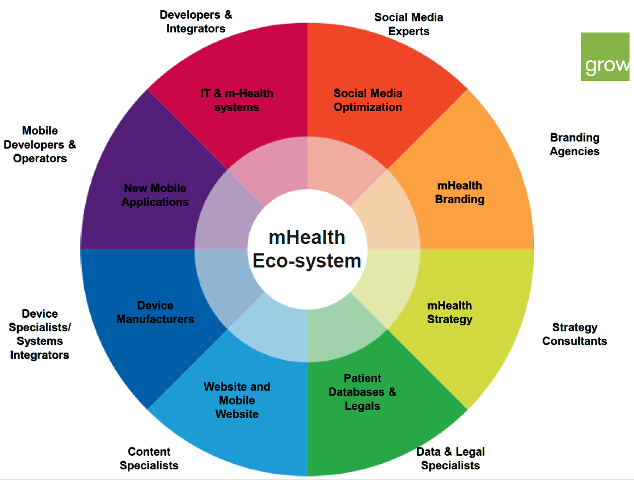
[Diagram provided courtesy of Grow].
According to Sophia Salenius of RegPoint one of the barriers to deployment of mHealth applications is the mobile network operator. The time and cost involved is minimal. The benefits could be vast. A network operator only needs to invest a minimal amount of time and effort deploying a simple solution to market. Network operators represent a small but significant stakeholder group who - generally speaking - have yet to embrace health solutions in western markets. In developing countries the picture is different with government, charities and operators working together to deliver health information and services.
Other stakeholders include the pharmaceutical industry, which could gain insight into the way their drugs are being used, improving the time and reducing the cost of enhanced versions. Healthcare professionals and organisations could become more effective and efficient as they would have a more accurate and time-effective method of helping people. mHealth application will become a significant niche for tablet vendors whose product represents a natural platform for managing patient records. Of importance is the ability to present information to patients in a form they will better understand.
Privacy was discussed at length. Solutions that centralised patient information in a secure environment, only using the mobile network and device for data capture and limited feedback using secure connections, represented little threat. Of more concern was the use of mobile devices to gain access to and edit detailed information about an individual, either directly or indirectly.
Coming back to our original question it seems the value of mHealth will be improved quality of life for people... and animals. However the relatively small role mobile plays in the end-to-end proposition could result in an overly inflated view of the mobile industry's role. Mobile operators enable bits of data to be moved from A to B, facilitating a dialogue between people or machines that otherwise could not happen. Without mobile operators this cannot happen. However the people that need to make health care solutions work are medical professionals. Mobile network operators would be well advised to listen to and help them rather than try and second-guess what they need.
Unsurprisingly, Mobile Monday London runs events on Monday evenings in the London area. The events they arrange are a great way to find out about an increasingly wide range of mobile-related subjects and, just as importantly, meet some very interesting people. Find out more at on the Mobile Monday London blog. And there'll be an audio report from the mHealth event in next week's podcast at TheFonecast.com.