Mark Bridge writes:
Last week the Wall Street Journal published a feature that explained how techies in New York wanted the city’s 212 area code as part of their mobile phone numbers. This may seem strange from a UK perspective until you realise that American mobile phone numbers – okay, I’ll call them cellphone numbers if you want – don’t have dedicated mobile ‘dialling codes’. Instead, they’re all prefixed with a local area code and cost the same to call as those landline numbers they mimic. The downside from a user’s point of view is that each mobile phone owner pays to receive calls. Here in the UK, the higher price of calling mobiles means we receive calls for nothing.
Anyway, back to the story. 212 is the original area code for New York, New York. So good, they named a fragrance after it. It’s rather like 0171 for central London.
As the demand for fixed-line numbers has grown, new area codes have been introduced. In the UK we went from 01 for London to 071 and 081, then 0171 and 0181, followed by the 020-prefixed groups of 020 7, 020 8 and 020 3. In NYNY, Manhattan added 646 and 917, while the other New York boroughs were given 718, 347 and 929.
The city’s run out of 212 numbers but that hasn’t stopped New Yorkers finding ways to acquire a 212 cellphone number, according to the article. A 212 number is a status symbol, says the WSJ, a mark of authority, a sign of the ‘early adopter’.
Here in the UK, the cellular mobile phone system has always had its own distinct mobile prefixes. The coolest people – and those who had friends in the number allocation department of service providers – tended to favour mobile numbers with repeating or sequential digits. And the introduction of Mobile Number Portability in 2001 meant they could take their memorable numbers to new networks; no more identifying Vodafone users by their 0836 prefix, Cellnet from 0850 or one2one from 0956.
A couple of years later, MNP – known to its Stateside friends as WLNP (Wireless Local Number Portability) – arrived in the USA. In many ways it’s more flexible than the UK system because numbers can be moved between landlines and mobile phones. The consumer also deals with the ‘pleased to meet you’ recipient network, not the potentially grumpy network they’re leaving.
However, all this leaves me wondering how long it'll all last. As households drop fixed lines in favour of mobile phones, it seems that the apparent location of a user and the area code they claim will become irrelevant. In fact, for many people, the country code is also becoming irrelevant. So… what happens next? We already have a variety of services that can help – from the international network codes of +882 & +883 and the tel domain to call diversion services and the likes of Truphone Local Anywhere – but none of them have all the answers. At least, I don’t think any of them have all the answers. If anyone can convince me otherwise, we’ll turn it into a feature on The Fonecast. Until then, I'll cherish my current mobile number and its ancient Vodafone MetroCall prefix!
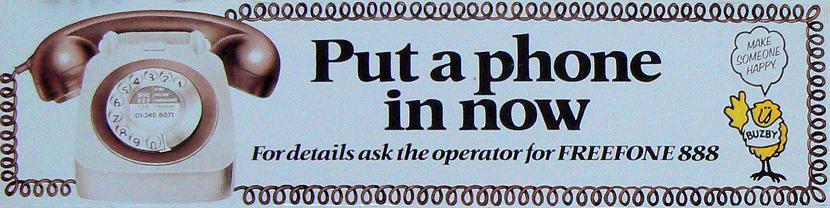
[Image shows BT advertisement from around 30 years ago]